AI Investment Compared to the Largest Megaprojects in History
Good Ancestors
Enormous capital is flowing into AI.
In May 2026, the Goldman Sachs Global Institute estimated $7.6 trillion would be spent on compute, data centres, and power between 2026 and 2031.
We compared that estimate against four of the largest megaprojects in modern history (see below figure). The AI buildout is projected to spend more in six years than the Interstate Highway System, Apollo, the International Space Station, and the Manhattan Project spent between them across six decades.
Although we can't measure projected AI spend as a proportion of GDP, we can look at recent AI capital expenditure in the US and compare it to the US housing boom of the 2000s. Doing so shows that the AI investment boom is moving twice as fast as the housing boom was at its fastest.
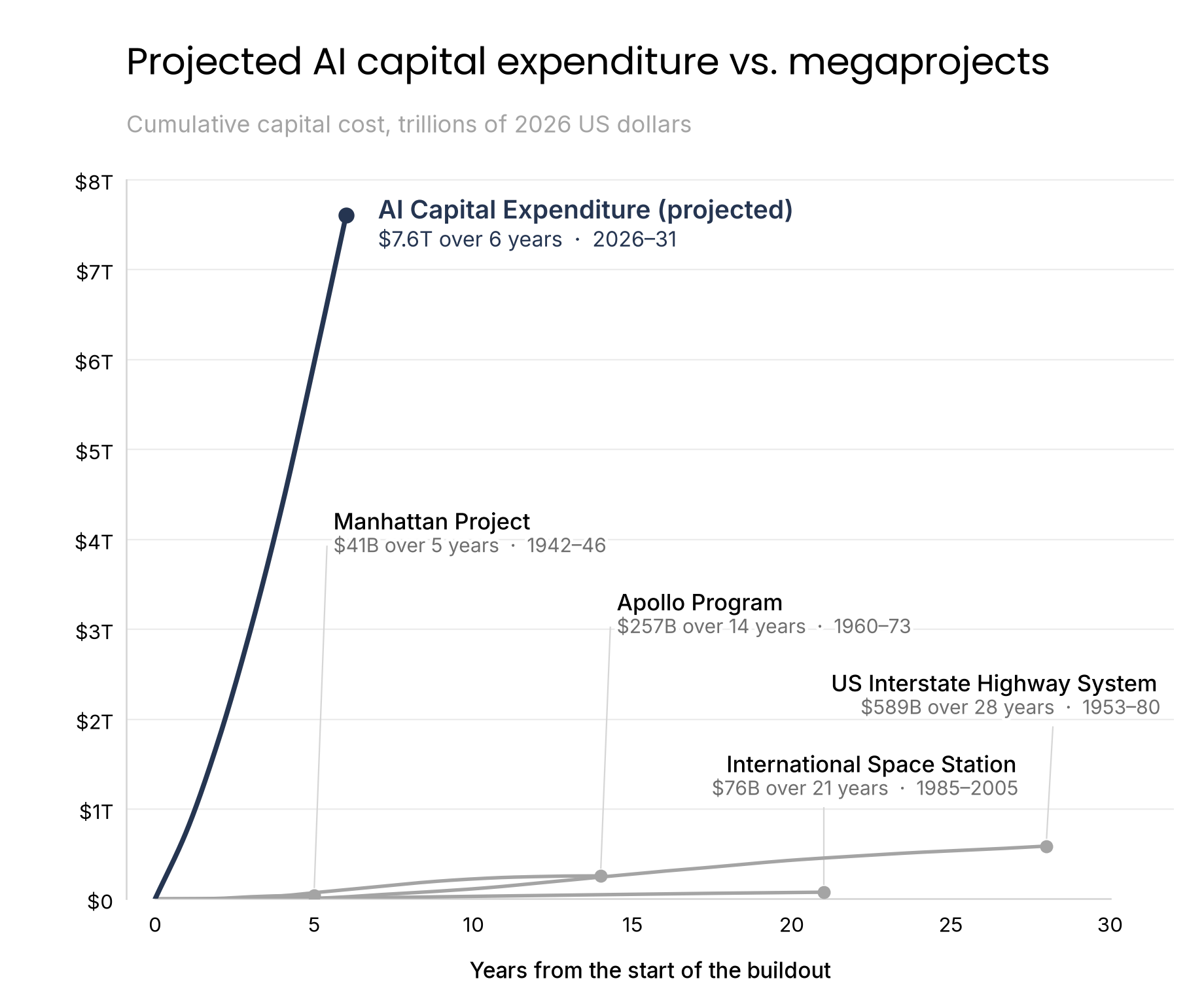
Cumulative capital cost of each buildout, converted to 2026 US dollars and counted from its own first year of spending. The AI series is a forward projection of global spending on compute, data centres, and power, while other megaprojects are actual recorded spending. Interstate figures add 10% to the federal total for the state share and stop at 1980, after which the reported spending is mostly repairs and widenings of existing highways rather than building out new highway systems. ISS covers the US contribution only and stops in 2005 when the reporting methodology changed; Apollo counts NASA's direct and indirect costs.
Sources: AI – Goldman Sachs, 'Tracking Trillions' • Interstate – FHWA Highway Statistics Summary to 1995, table FA-203 • ISS – Congressional Research Service IB93017 • Apollo – Dreier, Space Policy (2022), via The Planetary Society • Manhattan Project – Manhattan District History, Vol. 5 (DOE OpenNet). Inflation adjustment: CPI-U, Minneapolis Fed. (spreadsheet)
There are two caveats to this comparison.
-
Labour was cheaper 80 years ago than it is today. A dollar of 1946 spending bought more hours of work than adjustment for inflation implies. Adjusting for this would narrow the gap but would not change the overall ranking. The AI projection exceeds the four historic programs combined by a factor of about seven.
-
The AI figures are a projection, while everything else is recorded spending. Goldman's assumptions could prove wrong in either direction. But even if they are overestimated by a factor of four, the buildout would still outspend every project on this chart combined, and do it in a fraction of the time.
AI progress has followed a consistent trend: more compute, more data and better algorithms produce more capable models. Capital is pouring in at an unprecedented scale, and the AI buildout is on track to be perhaps the largest undertaking in human history. We should not be surprised if AI capabilities continue improving, along with the risks they pose.