Australia's Position in the Age of AI
The Commonwealth Government of Australia
Key Resources
AI development is rapid, accelerating, and on track to upend geopolitics and the global economy. Australia needs to find valuable positions in a world with highly capable AI, and then use those positions to secure our national interests — whatever other countries and companies do, and however the technology unfolds.
For the purpose of this report, we consider positions valuable when they secure Australia a place in the economy and supply chains that will underpin future prosperity; give Australia something to offer our allies and regional partners that they cannot easily obtain elsewhere; or reduce Australia's dependence on decisions made offshore.
Ten possible positions
This report identifies and analyses ten positions Australia could pursue to establish its place in an AI future:
-
Attract frontier AI training: Australia could attract one or more frontier AI companies to make their future AI models in Australia.
-
Build inference capacity for Australia and the region: Australia could have enough domestic AI inference compute to meet domestic demand and be a net exporter.
-
Secure industries across the AI value chain: Australia could secure multiple valuable places across the AI supply chain, beyond hosting AI training and inference compute.
-
Fund narrow AI models in areas of national strength: Australia could support the development of truly sovereign small or narrow AI models in areas of national strength.
-
Develop a sovereign fast chaser: Australia could support the development of an Australian "fast-chaser" AI model that aims to have most of the performance of frontier models at a fraction of the cost.
-
Coordinate with middle powers on AI: Australia could use its influence and trusted relationships to coordinate middle powers on reducing AI risks and mitigating power concentration.
-
Fund a world-leading AI Safety Institute: Australia could have a world-leading AISI that makes a meaningful contribution in one or more critical areas of technical AI safety, in ways legible to our allies and frontier AI companies.
-
Drive AI adoption across industry: Australia could accelerate the safe and responsible adoption of AI across domestic industry.
-
Invest in AI-proof industries: Australia could invest in industries unrelated to AI but that are likely to become much more valuable in a world with cheap intelligence available at scale.
-
Host the new industries that AI will create: Australia could prepare for a large expansion in energy, land use, and industrial capacity so that the new industries AI creates are built here.
Assessing the positions
Good Ancestors assessed each of the ten positions on two measures. Value is how much Australia gains if we attain the position, through a place in the future economy, value to allies, or reduced dependence on decisions made offshore. Feasibility is how likely Australia is to attain the position, given legal, financial, competitive, and political hurdles.
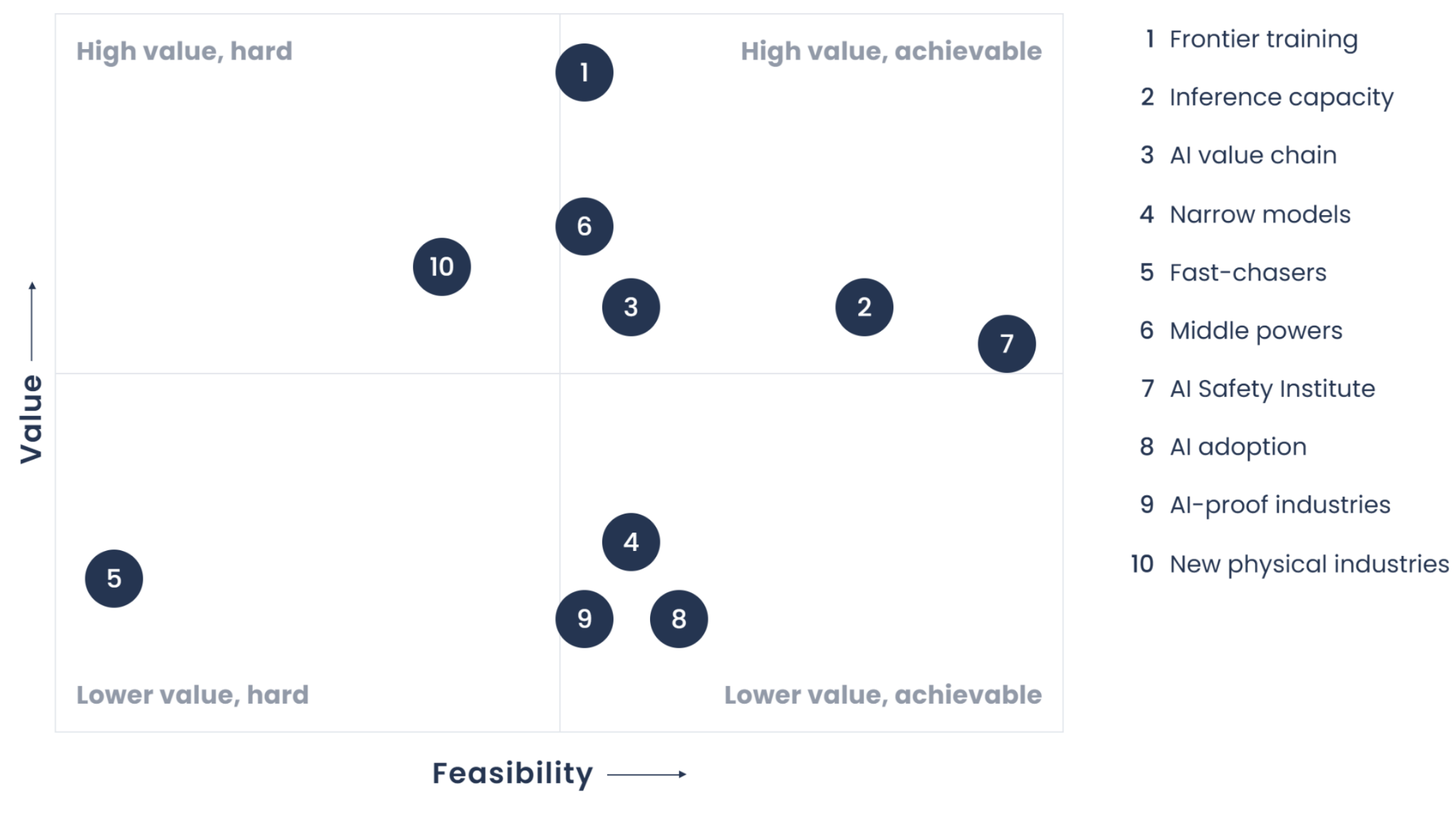
Two positions emerged as most promising:
-
Funding a world-leading AI Safety Institute rated highest overall. The AISI has recently been established, and sharing world-leading research has significant value. The main hurdles to overcome are addressing the funding shortfall and driving a research agenda that interests our allies and leading AI companies.
-
Attracting frontier AI training rated highest on value. Australia is an attractive destination to train frontier AI models, and AI companies are showing interest. Feasibility is constrained by copyright law rather than Australia's suitability on other dimensions.
Of the ten positions evaluated, developing a sovereign fast chaser rated lowest overall. An Australian sovereign model may not outperform comparable models on key attributes, like price, and the required investment is still substantial.
Copyright law is a hurdle across several of the positions, including hosting frontier AI training, building inference capacity, and developing sovereign fast chasers or narrow AI models.
Australia's AI compute gap
The report includes the first published estimate of Australia's AI inference capacity and demand. We estimate that Australia currently hosts enough AI compute to serve around 39% of our own inference demand — around 0.4% of global AI compute capacity.
Announced builds will not keep pace with demand. Based on limited data, we assess that Australia will meet less than a quarter of its inference demand by the end of 2027. To safeguard AI and data sovereignty, Australia should be able to meet its domestic inference demand — including as that demand grows — with a significant surplus.
If you would like to discuss the report or propose further research, please contact us at contact@goodancestors.org.au.